Now Reading: Can Dogs Smell Through Vacuum Sealed Bags?
- 01
Can Dogs Smell Through Vacuum Sealed Bags?

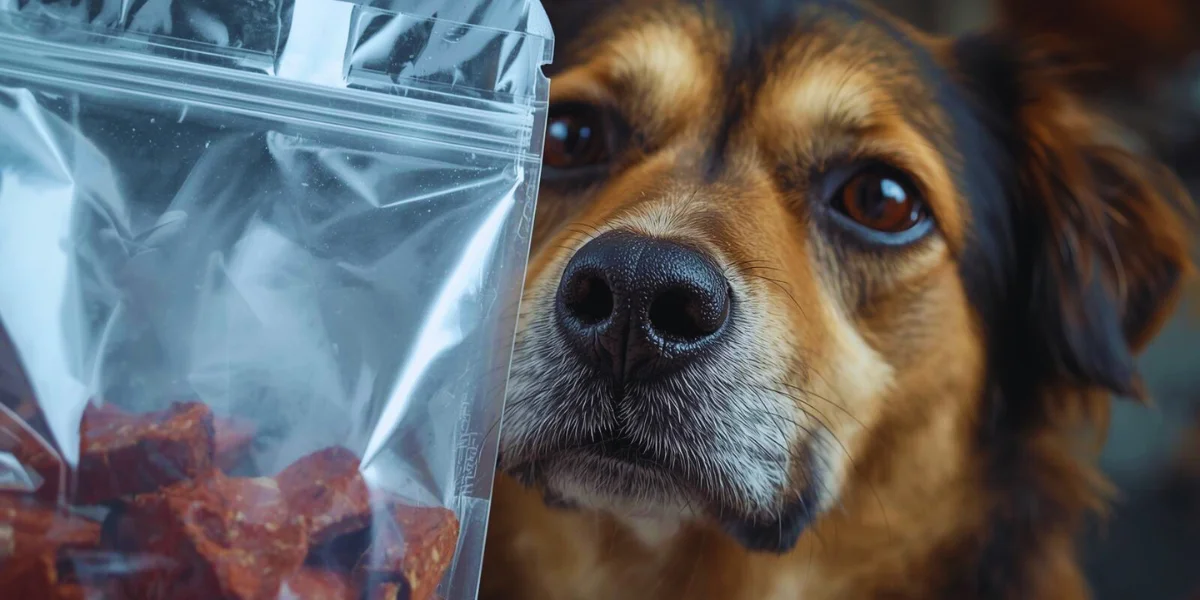
Yes, dogs can often smell through vacuum-sealed bags.
Vacuum sealing reduces odour by removing air, but it does not block microscopic scent molecules. Trained scent detection dogs can detect volatile organic compounds (VOCs) that escape through plastic, weak seals, or surface contamination.
The real answer depends on material type, seal integrity, temperature, and whether the dog is professionally trained.
Can Dogs Smell Through Vacuum-Sealed Bags?
Yes, dogs can often smell through vacuum-sealed bags because scent molecules can escape through plastic, imperfect seals, or surface residue.
Vacuum sealing reduces odour but does not create a completely scent-proof barrier, especially against trained detection dogs.
Why a Dog’s Nose Is So Powerful
The dog’s nose is a biological odour detection system that greatly surpasses the capability of the human sense of smell.
There are as many as 300 million olfactory (smell) receptors in the noses of dogs, whereas there are only six million in the noses of humans. The olfactory bulbs in the brains of dogs process scents with approximately 40 times more brain power than their human counterparts. Therefore, it can be said that while dogs smell better than humans, they also smell different; dogs can detect distinct layers of scent from a single odour.
As a result, this allows dogs to find extremely small amounts of volatile organic compounds when the amount of these compounds present in a sample is measured in parts per trillion.
Breeds commonly used in professional detection include:
- German Shepherd
- Belgian Malinois
- Labrador Retriever
According to the AKC, a dog’s sense of smell is their primary way of experiencing the world, making it one of the most powerful biological detection tools in the animal kingdom.
What “Vacuum Sealed” Actually Means
Vacuum sealing removes most air from inside a package and heat-seals it shut.
It does not mean:
- Completely odour-proof
- Molecularly impermeable
- Immune to diffusion
Most consumer vacuum bags are made from polyethylene or nylon blends. These polymers slow oxygen exchange but still allow small amounts of gas transmission over time.
It is where polymer permeability and gas transmission rate matter.
How Odour Escapes a Vacuum Sealed Bag
Even when properly sealed, scent can escape in several ways:
- Molecular Diffusion
Plastic is not solid at the molecular level. VOCs migrate slowly through polymer chains.
- Seal Micro-Gaps
Heat seals can contain microscopic imperfections invisible to the eye.
- Surface Contamination
If hands touch the outer bag after handling contents, scent molecules transfer outside. Dogs often alert to exterior residue.
- Temperature Effects
Heat increases vapour pressure and accelerates odour diffusion. Warm environments increase leakage risk.
Detection Dogs vs Household Dogs
Not all dogs have the same sensitivity level.
| Type | Training Level | Detection Accuracy |
| Household pet | None | Moderate curiosity |
| Scent-trained dog | Structured | High |
| Professional K9 unit | Certified | Extremely high |
Detection dogs undergo scent imprinting and conditioning. Their ability to identify trace odours is far beyond typical pets.
Real World Example:
A well known real world example is airport customs operations. K9 units at major international airports regularly detect vacuum sealed contraband hidden inside multiple layers of plastic, coffee grounds, and sealed food products. These dogs are not reacting to large odour clouds. They are alerting to microscopic scent traces that have migrated through packaging over time. This demonstrates that vacuum sealing, while effective for food freshness, was never designed to defeat a trained canine nose
The American Veterinary Medical Association (AVMA) recognises scent detection as one of the most reliable and scientifically validated uses of canine ability in both law enforcement and medical settings.
Does Freezing Reduce Smell?
Cold temperatures slow molecular movement and vapour release.
However, freezing does not eliminate scent molecules. Once returned to room temperature, diffusion resumes.
Can Airport or Customs Dogs Smell Through Sealed Plastic?
Professional K9 units used in airport security and border control are trained to detect extremely small scent concentrations.
Vacuum sealing alone is not considered reliable protection against trained detection dogs.
Decision Guide: Is Vacuum Sealing Enough?
Ask yourself:
- Is the goal food freshness or scent concealment?
- Is the concern household pets, wildlife, or trained detection dogs?
- Is the packaging single-layer or multilayer?
- Will it be stored in warm conditions?
For home food storage, vacuum sealing works well. For wildlife camping, odour control requires additional containment. In professional scent-detection scenarios, vacuum sealing alone is unreliable.
Common Myths
“If there’s no air, there’s no smell.”
False. Scent molecules remain embedded in materials.
“Smell-proof bags are completely smell-proof.”
Most reduce odour significantly, but do not guarantee zero transmission.
“Thicker plastic solves everything.”
Thickness helps, but barrier composition matters more than bulk.
Practical Tips to Reduce Odour Transmission
- Use multilayer barrier films instead of thin plastic
- Avoid touching the outside after sealing
- Store in airtight secondary containers
- Keep items cool
- Replace worn or reused bags
Layered containment is more effective than relying on a single barrier.
FAQ’s
Q: Do Vacuum-Sealed Bags Stop Smell Completely?
No. They reduce odour but do not fully block molecular diffusion.
Q: Can Dogs Smell Through Double Vacuum Sealed Bags?
They often can, especially trained detection dogs. Double layers lower the risk, but don’t eliminate it.
Q: Can Dogs Smell Through Freezer Bags?
Freezer bags are thinner and more permeable than multilayer vacuum packaging.
Q: Can Dogs Smell Through Glass Jars?
Glass is less permeable than plastic, but scent residue on the outside can still be detected.
Q: How Far can Dogs Smell Something?
It depends on wind, humidity, and scent strength. Under ideal conditions, detection distances can be significant.
Q: Are Smell-Proof Bags a Scam?
Not necessarily. They reduce odour transmission, but marketing claims often overstate total effectiveness.
Q: Does Heat Increase Odour Leakage?
Yes. Higher temperatures increase molecular activity and speed up diffusion.
Q: How are Police Dogs Trained to Detect Scents?
They undergo scent imprinting, reward conditioning, and controlled exposure training to identify specific odour profiles.
Conclusion
Dogs possess an extraordinary sense of smell capable of detecting microscopic scent molecules. Vacuum sealing reduces odour transmission, but it does not create a molecular barrier.
Material type, seal integrity, temperature, and surface contamination all influence outcomes. For basic food storage, vacuum sealing is effective. For high-level scent-detection scenarios, multilayer barriers and secondary containment offer better protection.
Understanding the science behind polymer permeability and canine olfaction helps set realistic expectations, and prevents costly assumptions.
Disclaimer: This article is for informational purposes only and does not substitute professional veterinary advice. Always consult a licensed veterinarian before making any health or dietary decisions for your dog.