Now Reading: What Is Hand Stripping in Dog Grooming? (And Why Most Groomers Won’t Tell You This)
- 01
What Is Hand Stripping in Dog Grooming? (And Why Most Groomers Won’t Tell You This)
What Is Hand Stripping in Dog Grooming? (And Why Most Groomers Won’t Tell You This)

You’ve likely heard about “hand-stripping” (even though you may not be sure what that means), especially if you have a Terrier, a Schnauzer, or a Cocker Spaniel. Most of what I read about hand-stripping is oversimplifications, and far too many authors make it seem way more complicated than it really is.
Hand-stripping is not a mystery. Hand-stripping is an intentional grooming technique created specifically for a certain type of coat. When done properly, hand-stripping can be very comfortable for your dog, keep their coat in good condition, and promote better skin and coat health in the long run.
This article will cover all aspects of hand-stripping, including what hand-stripping is, which breeds require hand-stripping, hand-stripping vs clipping, the tools you’ll need, the time involved with hand-stripping, when to begin hand-stripping your puppy, and when not to perform hand-stripping. Nothing but pure information in this article – no fluff or filler!
What Is Hand Stripping in Dog Grooming?
Hand-stripping involves pulling the entire dead hair shaft (with the hair follicle) out by hand, either by hand or with the use of a specialized stripping knife, rather than simply cutting off the dead ends of the hairs as is done when using clippers.
The key point here is “hair follicle”.
Clipping involves cutting off the dead hair with scissors, while hand-stripping involves removing the entire dead hair, along with the hair follicle itself. This allows room for the dead hair to be replaced with a brand-new coat that grows correctly.
To think of this another way… clipping can be likened to mowing a lawn (cutting off the grass, but leaving the roots). Hand-stripping is similar to removing weeds (pulling up the entire weed plant, including the roots).
Wire-haired and rough-coat dogs experience a cyclic pattern of hair growth. At the end of each cycle, the coat ceases to grow, but the hair does not shed as easily as the short coat of a Labrador. In order to allow the new coat to grow back properly textured and coloured, the dead hair has to be pulled out manually.
Why is this important? When wire-coated dogs are clipped as opposed to being hand-stripped, the cut-off hair breaks down over time and loses its structure. Ultimately, the once rugged, water-resistant coat will become soft and dull, prone to matting, and lose its ability to protect the dog. The effects of improper stripping on a wire-coated breed are not merely cosmetic; they have an impact on the functionality of the coat itself.
The Coat Growth Cycle: When Timing Matters
This information is typically overlooked in many grooming articles; however, understanding the coat’s growth cycle is essential for effective hand-stripping techniques.
There are four phases in which dog hair grows, as stated by the American Kennel Club:
- Anagen: The growth phase. Hair is growing from the follicle.
- Catagen: Transition phase. Hair is slowing and eventually will stop growing.
- Telogen: Resting Phase. The hair is no longer growing and is simply at rest within the follicle. This is the optimal timing for hand-stripping. Dead hair is loose and can easily come out with little to no pain to the dog.
- Exogen: Shedding Phase. Hair has finished its growth and will eventually fall out on its own.
Hand-stripping can only occur during the Telogen phase, because the dead hair that is loose within the follicle will pull out with minimal discomfort to the dog. Hand-stripping should never occur during the Anagen phase (hair is actively growing) as it may cause the dog some discomfort.
How to know if the coat is ready: To determine if the coat is ready, gently run your fingers through the coat in a backward motion, working against the grain of the hair. If the hairs stand up and do not lay flat, then the coat is ready. If the hairs spring back into place flat and feel snug against the skin, then the coat is not yet ready. You can also have a professional groomer verify whether or not the coat is ready to be stripped.
What Dog Breeds Need Hand Stripping?
One thing you need to remember is that how a dog’s coat is hand-stripped depends on its coat type, not just its breed name. Even within the same breed, different dogs may have coats that will respond differently to hand stripping.
That said, the most common breeds of terriers fall into these groups:
Terrier Breeds
- Wire Fox Terrier
- Welsh Terrier
- Airedale Terrier
- Border Terrier
- Scottish Terrier
- West Highland White Terrier (Westie)
- Lakeland Terrier
- Jack Russell Terrier (wire-haired variety)
Sporting and Working Breeds
- Wire-haired Dachshund
- German Wirehaired Pointer
- Standard Schnauzer (and Miniature Schnauzer in show trim)
- Irish Wolfhound
- English Cocker Spaniel (show dogs)
Other Breeds
- Bouvier des Flandres
- Brussels Griffon (rough coat)
- Wirehaired Pointing Griffon
One important note:
Not all terrier breeds require hand stripping. Bull Terriers, Boston Terriers, and American Hairless Terriers are terrier breeds with smooth coats that don’t benefit from this technique. It is the coat texture and not the word “terrier” in the breed name that matters.
Hand Stripping vs Clipping: What Actually Happens When You Choose Wrong
What you need to know before deciding on the right course of action for your dog.
| Hand Stripping | Clipping | |
|---|---|---|
| Coat Texture | Stays wiry, dense, and correct | Becomes soft and fluffy over time |
| Coat Colour | Rich, vibrant, true to breed standard | Fades to a lighter, duller shade |
| Waterproofing | Maintained in new growth | Lost as coat softens |
| Skin Health | Follicles stay clear, skin breathes | Dead hair blocks follicles over time |
| Cost | Higher, specialist skill required | Lower, widely available |
How switching works: Switching from clipping to hand stripping may be possible if your wire-coated dog has had a lot of clipping done previously. However, there will likely be a few stripping sessions until the coat returns to its original state. The longer an owner clips their dog, the softer the coat is typically going to be.
Hand Stripping Tools for Dogs: What You Actually Need
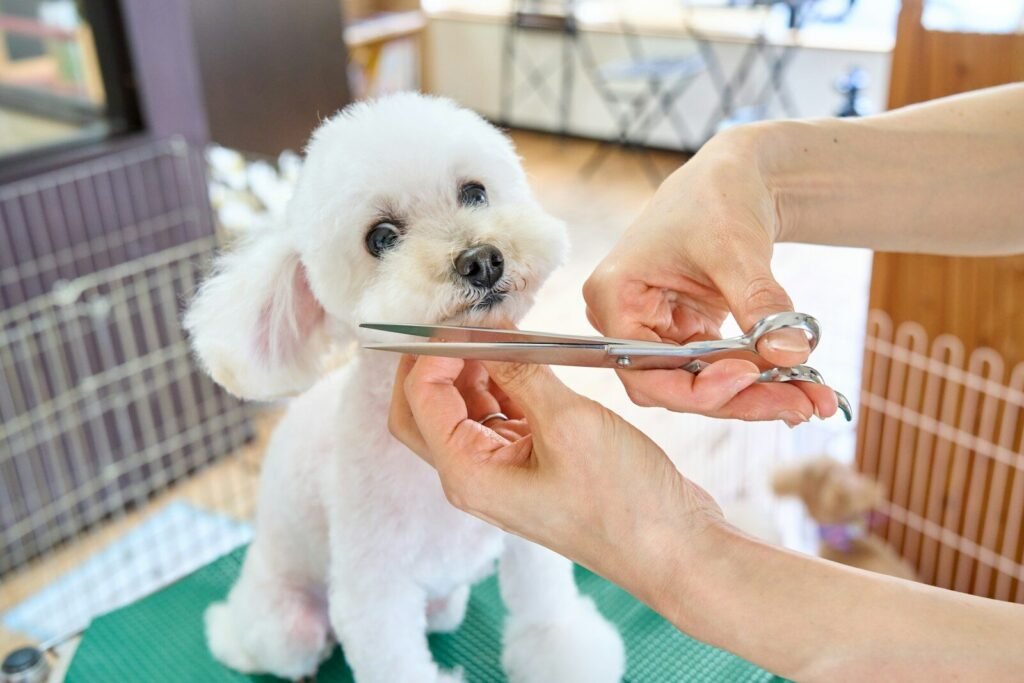
The right tools are important to the success of a proper stripping experience; the wrong tools add time and discomfort for the dog and make the job much harder for you.
Stripping Knives
Despite the name, a stripping knife does not cut hair. It grips the dead coat and helps you remove it from the root in controlled sections. The serrated edge holds onto loose hairs as you pull.
- Fine-toothed knives are best for finishing touch-ups on sensitive areas such as the head, ears, and tail.
- Medium-toothed knives are the most versatile and should be the first choice for beginners.
- Coarse-toothed knives are best for removing large amounts of heavy, thick coats in the early stages of stripping.
Tip for Beginners: When selecting a stripper knife, always check the blade. Hold a piece of hair in front of you that has been removed from the coat. If the hairs are the same length and there is an obvious root at the end, the blade is dull enough and functioning properly. If the hairs vary in length, the blade is probably cutting rather than holding onto the hair.
Rubber Thimbles and Grip Aids
Rubber thimbles and grip aids fit onto your thumb and forefinger and provide you with a better grip when trying to grasp individual hairs. These are very helpful when doing hand plucking in sensitive areas such as the face, ears, and around the eyes.
Stripping Powder or Chalk
Before you strip the coat, apply some grooming chalk or powder. Grooming chalk or powder will add grip to the hair, reduce slipping, and make the stripping process go faster and more efficiently. One of the least used tools by new grooms is this product.
Pumice Stone
If you lightly rub a pumice stone over the coat prior to stripping, you can break loose the dead hair, which will give you less resistance to pulling, and make the experience easier on both you and the dog.
Slicker Brush and Undercoat Rake
You will want to use a slicker brush and an undercoat rake before and after you strip the coat. Prior to stripping, these tools will remove tangles and surface dirt from the coat. After you finish stripping, they will help you distribute the remaining coat and assist in finding any spots where the coat may be uneven.
How to Hand Strip a Dog: Step by Step
Hand stripping is a skill that takes time to develop. Your first couple of experiences will take longer than subsequent experiences. Follow this step-by-step process for hand stripping a dog.
- Assess the coat before you begin. Run your fingers against the direction of growth. If the coat stands up and the hair pulls out easily with light pressure, it is ready.
- Do not bathe the dog before stripping. A clean coat is slippery. The natural oils and slight grime actually help you grip the hair. Bathe after the session if needed.
- Apply stripping powder or chalk to the area you are working on. This improves grip significantly.
- Keep the skin taut with one hand while you grip a small section of hair between your thumb and forefinger or a stripping knife with the other. Pull firmly but smoothly in the direction of hair growth.
- Always strip with the direction of growth. This keeps the new coat growing in the right direction and is more comfortable for the dog.
- Start along the topline from the back of the head to the base of the tail. This is the main jacket area and the safest place to begin.
- Use hand plucking only (no knife) for sensitive areas: the face, around the eyes, inside the ears, and the lower legs.
- Take regular breaks. Hand stripping a full coat in one session is tiring for both the dog and the groomer. Breaking it across two or three sessions is completely acceptable.
- Card the coat after stripping to remove any remaining loose undercoat. This also helps the skin breathe and prepares the follicles for new growth.
- Finish with a light brush through and a spritz of coat conditioner spray.
When to Start Hand Stripping a Puppy
This is something many first-time owners get wrong, and it matters.
The initial rough coat on wire-coated puppies starts to appear at about 8-12 weeks. Initially, the puppy coat feels soft and somewhat fuzzy. When the hairs grow out and stand further away from the body than they are in contact with the skin, and the hairs feel harsh to the touch, the coat is now ready to be stripped.
Christies Direct states that the first real stripping of a puppy (done with hands only) can occur from about 3 months of age, when the coat begins to “fizz” or stand away from the body, and the first adult coat can be seen below the puppy coat.
How this affects your dog:
A puppy that is introduced to hand stripping while still young (before 4 months of age) generally accepts all of its future sessions without struggle. The sooner you establish the good feeling associated with hand stripping, the easier the rest of your sessions will be.
A full strip of an adult coat normally occurs between 6 and 7 months of age, once the adult coat has reached its final length and the hair grows long enough to develop its own natural parting lines and clump together. Once these happen, the adult coat is ready to be completely stripped.
Read our Blog on: 7 Essential Dog Grooming Tips Every Owner Should Know
How Long Does Hand Stripping Take?
Border Terriers, Jack Russells, Welsh Terriers, and Wire Fox Terriers are just a few examples of breeds that benefit from frequent hand-stripping. The amount of time required to hand-strip these breeds varies, but here are some general guidelines:
- Small breeds such as Border Terriers or Jack Russells: 2-4 hours
- Medium breeds such as Welsh Terriers or Wire Fox Terriers: 3-5 hours
- Larger breeds such as Airedales: 5-7 hours (in some cases, this may take place over 2 sessions)
- Maintenance strips (rolling coat/strip not a full strip): 1.5-3 hours, depending on breed and coat condition
Many professional groomers also employ a “rolling” method to hand-strip terrier coats. Instead of hand-stripping all areas of the dog’s coat simultaneously, professional groomers strip each section at a different time. By doing so, the dog always maintains some level of jacket coverage, thus providing the appearance of a coat that never goes completely bare. In addition, this method is far less stressful to the dog and provides the owner with a year-round coat that looks its absolute best, rather than waiting for the full growth period prior to having the coat completely stripped.
Hand Stripping and the Cocker Spaniel: What You Need to Know
Cocker Spaniels are another matter altogether and, therefore, deserve to be discussed separately. The reason for this is the fact that pet owners receive many differing opinions regarding the care of their Cocker Spaniel’s coat.
Show-bred English Cocker Spaniels possess a smooth, flat, silky topcoat that is hand-stripped in the saddle area (back/sides) of the dog for the purpose of showing. Show-bred Cocker Spaniels are stripped using fingers and/or thinning shears as opposed to a stripping knife. This is due to the nature of the coat being softer and silkier than that found on a terrier.
Most pet Cocker Spaniels are either clipped/scissored, and while many groomers that work with pets do offer hand-stripping, they usually opt for carding instead of a full hand-strip. It is highly recommended for any pet Cocker Spaniel owner to seek out a groomer who specializes in spaniel coats before deciding what method is best suited for their individual dog.
When You Should NOT Hand Strip Your Dog
This section is equally important to everything covered in this manual.
- The coat is not yet ready for stripping. Stripping hair while it is in the active (anagen) phase of growth is not only painful for your dog, but also can create a permanent negative association with grooming.
- The dog is very young or elderly with sensitive skin. Both groups can find the process uncomfortable even when done correctly.
- The dog has been neutered or spayed, and the coat has changed. Neutering often causes the coat to grow softer. A softer coat may not strip well, and clipping may be the kinder option. A specialist groomer can advise you after assessing the coat in person.
- The dog shows signs of skin irritation, infection, or other dermatological conditions. Skin irritation or infections should always be resolved before beginning a groom.
- A “Blown Coat” is when the coat is allowed to go beyond the time frame that it is considered ready for stripping. The longer the hair is, the softer it becomes
and begins to be difficult to remove completely. Mildly blown coats can be stripped by a groomer. Severely blown coats may require clipping the coat down and starting from scratch as the best course of action.
Important: Never attempt to strip the coat of a dog that displays signs of anxiety or distress. If a dog is anxious, it will not remain still, and the chance of accidentally scraping the skin increases. Positive associations can be created with short handling sessions before proceeding with a complete groom.
Final Thought
Hand stripping has a reputation for being expensive, time-consuming, and only applicable to a select group of dogs. Those descriptions are partially accurate. Hand stripping is a skill that requires time and money. However, for dogs that truly require hand stripping, there is no viable alternative. A wire-coated dog that is hand stripped properly at the right time with the proper tools will have a coat that looks and performs better than any other clipped coat.
Start slowly if you are new to hand stripping. If possible, ask an experienced groomer to demonstrate the basic techniques of hand stripping. Give yourself time to develop the skills required for hand stripping. Stripping the first coat is usually the most difficult coat to strip.
Veterinary Disclaimer: This article is for educational purposes only and does not replace professional veterinary advice. If your dog has eaten something potentially harmful, contact your veterinarian or the ASPCA Animal Poison Control Center at (888) 426-4435 immediately.
About the Author
Faizan is the founder and writer behind Complete Dog Guide, a blog dedicated to helping dog owners with practical, well-researched information on dog food, care, grooming, and training. With 5 years of experience in content writing and blogging, he spends hours digging through veterinary publications, official guidelines from organizations like the ASPCA, AKC, AAFCO, and the Merck Veterinary Manual to make sure every article is backed by reliable sources.
Complete Dog Guide does not provide veterinary advice. Every health-related article on this site is researched using published veterinary data and clearly cites its sources. If your dog has eaten something harmful, always contact your veterinarian first.