Chihuahuas don’t have a great reputation. In spite of being one of the smallest dog breeds in the world, they are often described as irritable, quick-tempered, and extremely difficult to handle. But are Chihuahuas inherently aggressive, or are there other reasons behind it? The truth is that Chihuahua aggression is rarely a breed defect. In fact, this behaviour is the result of fear, poor socialisation, small dog syndrome, and common owner mistakes, and the good news is that with proper training and an understanding of the dog’s temperament, all of these issues can be addressed.
This guide sheds light on every aspect of Chihuahua aggression, why it occurs, and how owners can change it. Whether your Chihuahua is growling at strangers, getting into trouble with other dogs, or getting upset when picked up, the answers to all your questions are here.
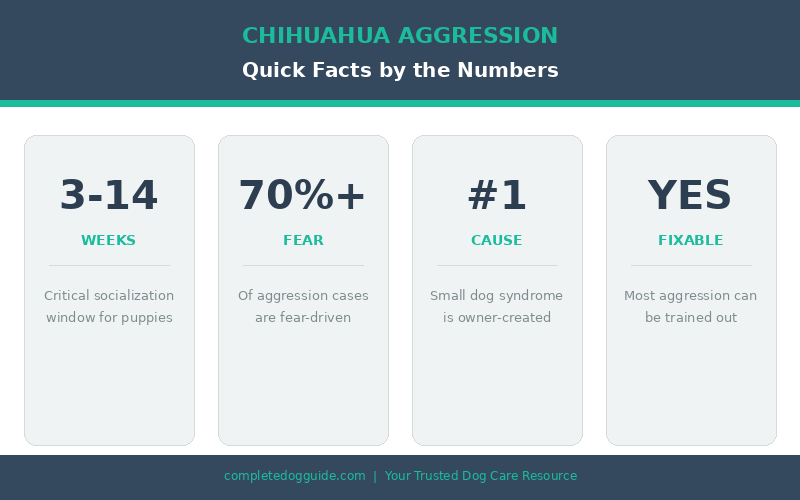
Chihuahua Aggression: Key Facts at a Glance
Many people believe that Chihuahuas are born with a bad temper. However, animal behaviourists repeatedly emphasise that no breed of dog is inherently aggressive. According to the American Kennel Club (AKC), Chihuahuas are loyal, affectionate, and agile by nature. However, their small size makes them more susceptible to danger, which can lead to a defensive behaviour that can appear aggressive. So when someone asks the question, “Are Chihuahuas aggressive by nature?” the simple answer is no. What people are actually seeing is a combination of fear, anxiety, and learned behaviours that owners unconsciously reinforce over time.
What Is Small Dog Syndrome in Chihuahuas?
One of the biggest reasons behind Chihuahua aggression is “small dog syndrome.” It’s not a medical condition, but rather a set of behavioural problems that develop when owners allow their small dog to do things they wouldn’t tolerate in a larger breed. Jumping up on people, growling at food, barking at everyone who comes near, and trying to bite when asked — these are all behaviours that owners often laugh off simply because the dog is small in size. The real problem is that the Chihuahua gradually learns that this behaviour works. Over time, he becomes more and more adept at using aggression as a weapon to control his surroundings. Small dog syndrome in Chihuahuas is entirely the owner’s own creation — and fortunately, it can be completely corrected with consistent boundary setting and regular training.
Common Types of Chihuahua Aggression
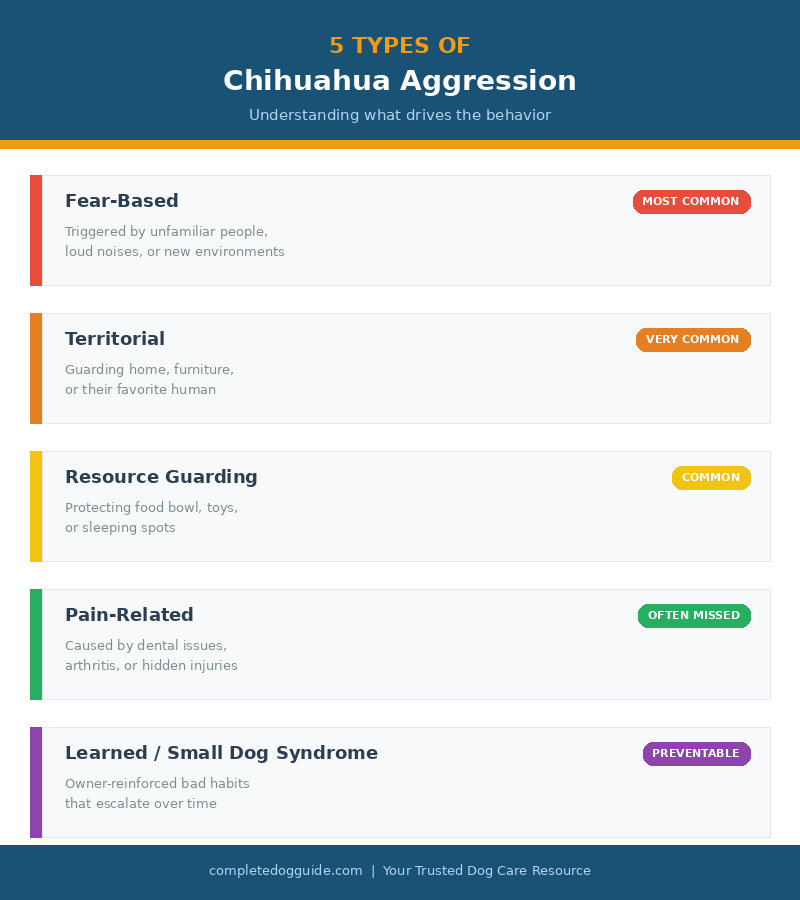
The five most common types of chihuahua aggression and how often they occur.
Chihuahua Fear Aggression
Fear aggression is by far the most common type in chihuahuas. Because of their tiny size, the world can feel like a very big and very scary place. Loud noises, unfamiliar people, new environments, and even sudden movements can trigger a fear-based response. A chihuahua that feels cornered or threatened may growl, snap, or bite as a way to protect itself. According to the ASPCA, fear-based aggression is one of the leading causes of biting behaviour in small breeds.
Chihuahua Aggression Towards Strangers
Chihuahua aggression towards strangers is closely tied to fear and lack of socialisation. A chihuahua that was not exposed to different people, sounds, and situations during its critical socialisation window (roughly 3 to 14 weeks of age) is more likely to view unfamiliar humans as threats. This is why so many chihuahuas bark, growl, and lunge at visitors or people on walks.
Chihuahua Aggression Towards Other Dogs
It is not uncommon for a chihuahua to pick fights with dogs ten times its size. Chihuahua aggression towards other dogs often stems from leash reactivity, frustration, or a lack of proper dog-to-dog socialisation. Some chihuahuas also develop this behaviour because their owners carry them or pick them up whenever another dog approaches, which teaches them that other dogs are something to be afraid of.
Chihuahua Resource Guarding Food
Resource guarding is another common trigger. When a chihuahua guards its food bowl, toys, or even a favourite spot on the couch, it can escalate to growling, snapping, or biting. Chihuahua resource guarding food is often reinforced when owners back away after the dog growls, because the dog learns that aggression gets results. Trading exercises, where the owner offers a high-value treat in exchange for the guarded item, are an effective way to address this.
Owners who use food-based training methods should also make sure they are only offering safe options. For example, not all human foods are suitable for dogs, and knowing which treats are safe and which are not can prevent unnecessary health issues during training.
Chihuahua Territorial Behaviour
Chihuahuas are fiercely loyal and can become extremely territorial over their home, their furniture, and especially their owner. Chihuahua territorial behaviour might look like barking at the doorbell, growling when someone sits next to their owner, or snapping at a family member who approaches “their” spot. This ties directly into the “one-person dog” tendency the breed is known for.
Why Does My Chihuahua Only Like Me?
Chihuahuas are notorious for bonding deeply with one person and being wary (or outright hostile) toward everyone else. This is sometimes called “velcro dog” behaviour. When someone asks, “Why does my chihuahua only like me?” the answer usually comes down to the dog’s attachment style. Chihuahuas that are carried everywhere, sleep in their owner’s bed, and are rarely exposed to other people can develop an almost possessive bond. That possessiveness often turns into aggression toward anyone who comes too close.
Why Do Chihuahuas Bark So Much?
Excessive barking and aggression are certainly closely related in Chihuahuas, but they are not the same thing. Some Chihuahuas bark simply because they are alert and sensitive, not because they are about to bite. However, when barking is accompanied by snapping, baring teeth, or growling, it is indicative of a deeper behavioural problem. Understanding why Chihuahuas bark so much can help owners identify whether their dog is simply being noisy but harmless, or is truly suffering from aggressive behaviour that needs immediate attention and correction.
Chihuahua Snapping Without Warning: The Signs People Miss
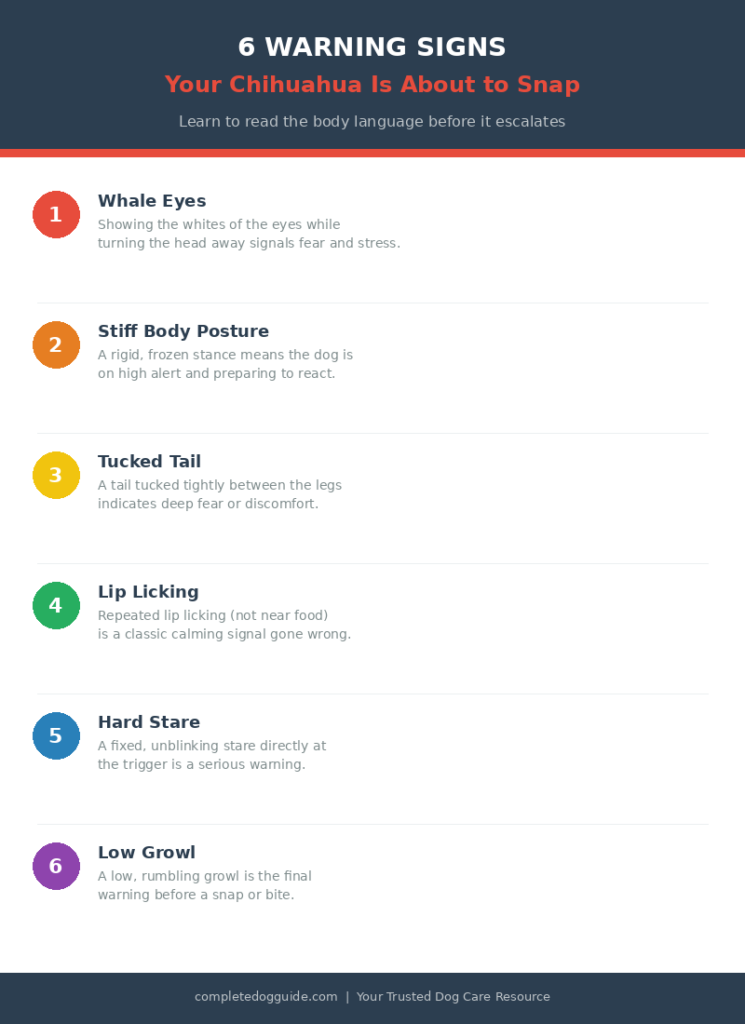
Many owners report that their chihuahua snapped “out of nowhere.” In reality, chihuahua snapping without warning almost never happens without some kind of body language signal first. Whale eyes (showing the whites of the eyes), stiff body posture, a tucked tail, lip licking, and a hard stare are all precursors to a snap or bite. The problem is that these signals are subtle, and many owners either miss them or dismiss them.
Six body language signals that come before a chihuahua snap or bite.
Why Do Chihuahuas Shake and Bite?
Shaking is extremely common in chihuahuas, and it does not always mean the dog is cold. Chihuahuas shake due to anxiety, excitement, low blood sugar, and overstimulation. When shaking is combined with biting or snapping, it is usually a sign that the dog is overwhelmed and in a heightened state of stress. Knowing why chihuahuas shake and bite helps owners recognise when their dog is approaching its threshold and needs to be removed from the situation.
Chihuahua Aggressive When Picked Up
When someone tries to pick up a Chihuahua, and he starts biting or growling, it could be due to physical pain, a past experience, or sensitivity to touch. Many Chihuahuas have kneecap (patella) and dental problems that can make it difficult for them to be picked up. If your Chihuahua is aggressive when picked up, it’s important to take him to the vet first to rule out any underlying physical problems — before assuming the problem is simply behavioural.
Are Male or Female Chihuahuas More Aggressive?
This is a common question, and the answer is nuanced. Some studies suggest that intact (unneutered) males may show slightly more territorial and dominance-related aggression, while females can be more prone to fear-based reactivity. However, the difference between individual dogs is far greater than the difference between sexes. Training, socialisation, and environment play a much bigger role than whether a chihuahua is male or female.
Are Long Hair Chihuahuas Calmer Than Short Hair?
This is one of those persistent myths that floats around Chihuahua communities. There is no scientific evidence that coat type affects temperament. Whether a chihuahua has long hair or short hair, its behaviour depends on genetics, early socialisation, training, and how it is treated at home. So if someone is choosing between the two based on aggression concerns, coat type should not be the deciding factor.
Is Chihuahua Rage Syndrome Real?
Chihuahua rage syndrome is a term some owners use to describe sudden, explosive aggression. True rage syndrome is an extremely rare neurological condition that has been documented primarily in English Springer Spaniels and Cocker Spaniels. It is not a recognised diagnosis in chihuahuas. What most people call “rage syndrome” in their chihuahua is usually unaddressed fear, aggression, pain, or a dog that has been pushed past its tolerance threshold.
Chihuahua Puppy Biting Stage vs Real Aggression
All puppies go through a biting phase, and Chihuahuas are no exception. Light biting and chewing are perfectly natural behaviours for a Chihuahua during their early teething years (around 3 to 6 months of age). The most important thing during this time is to direct their attention to appropriate chew toys and never use their hands as a plaything. However, if this biting continues after 6 months of age, intensifies over time, or is accompanied by growling and violent physical movements, this may be an early sign of increased aggression that requires prompt professional attention.
Old Chihuahua Suddenly Aggressive: What Changed?
When an older chihuahua suddenly becomes aggressive after years of being calm, something has changed. The most common causes include pain from arthritis or dental disease, cognitive dysfunction syndrome (the dog version of dementia), and loss of hearing or vision. An old chihuahua that is suddenly aggressive deserves a thorough veterinary exam before any behavioural modification is attempted.
How to Stop a Chihuahua from Biting
The journey to stop a Chihuahua from biting begins with understanding what is causing the behaviour. Once the trigger is identified, owners can adopt a positive reinforcement approach — rewarding calm behaviour, redirecting biting behaviour to toys, and gradually accustoming the dog to the stimuli that provoke it.
Punishment-based methods such as scolding, hitting, or coercing are not only ineffective but can actually escalate aggression. The American Veterinary Medical Association (AVMA) recommends reward-based training as the safest and most effective method for all breeds.
How to Socialise an Aggressive Chihuahua
Socialisation is the single most powerful tool for reducing aggression. But when it comes to an already-reactive dog, the approach needs to be slow and controlled. To socialise an aggressive chihuahua, owners should start with calm, low-stimulation environments and gradually increase exposure to new people, dogs, and situations. Forcing a fearful chihuahua into overwhelming social settings will only make the aggression worse. Patience, consistency, and plenty of treats go a long way.
How to Discipline a Chihuahua Without Hitting
Physical punishment has no place in dog training, period. Knowing how to discipline a chihuahua without hitting involves redirecting unwanted behaviour, using firm (but calm) verbal cues, and reinforcing the behaviours owners want to see. Time-outs, where the dog is calmly removed from the situation for 30 seconds, can be effective for interrupting escalating behaviour. The goal is to teach the chihuahua what to do instead of what not to do.
Can You Train Aggression Out of a Chihuahua?
The truth is, yes. Aggressive behaviour due to fear, poor socialisation, or learning can improve through regular training. However, this will take time. Owners should not expect an immediate change. While some dogs may never have a high level of aggression tolerance, their aggression can still be reduced both in frequency and severity by utilising proper management techniques and training.
Chihuahua Aggression at the Vet
Vet visits are stressful for many dogs, but chihuahuas can be especially dramatic. Chihuahua aggression at the vet is usually rooted in fear of handling, unfamiliar smells, and past negative experiences. Owners can help by bringing high-value treats, practising handling exercises at home (touching paws, ears, and mouth gently), and asking the vet about Fear Free certified practices that specialise in low-stress handling. Building a regular grooming routine at home is one of the best ways to get a chihuahua comfortable with being touched. Dogs that are used to having their paws, ears, and mouth handled during grooming are significantly calmer during vet exams.
Does Spaying or Neutering Reduce Aggression?
Many pet owners ask themselves if their Chihuahua’s aggression disappears once they are spayed/neutered. While hormonal changes may be responsible for a decrease in some forms of aggression (e.g., territorial marking by males & male-male guarding), it does not fix everything. Once a dog is fixed, fear-based aggression, resource guarding, and learned aggressive behaviour remain; therefore, behavioural training must accompany any surgical intervention.
Do Chihuahua Mixes Inherit Aggression?
Some people may be worried about possible temperament problems when adopting a chihuahua mix. For most breeds, including the chihuahua, temperament problems are caused by a combination of genetics (what they inherited) and environment (where they grew up). Therefore, you have a better chance at raising an aggressively calm chihuahua mix if it grows up in a happy household. You are much more likely to raise an aggressive chihuahua if you buy one that has been neglected and/or poorly trained.
The Best Treats for an Aggressive Chihuahua
Some of these treats are specifically designed to help your dog relax. While all of us agree that training is the first line of defence against aggression, some products can provide your dog with some extra support while you train him. Typically, the top-rated calming treats for aggressive chihuahuas include ingredients such as L-theanine, chamomile, valerian root, or melatonin. Owners of small breed dogs seem to really like Zesty Paws Calming Bites and VetriScience Composure. Remember, however, no product will ever cure an aggressive chihuahua. Calming treats can only be effective when used as part of a complete training program. Always consult your veterinarian before giving your pet anything new.
Are Chihuahuas Good with Kids?
This depends entirely on the individual dog and how the household is managed. Chihuahuas are fragile and can be easily injured by rough toddler handling, which makes them more likely to snap in self-defence. Are chihuahuas good with kids? They can be, but only with proper supervision, training, and teaching children how to interact gently. Most breed experts recommend chihuahuas for families with older children who understand how to respect a small dog’s boundaries.
Do Chihuahuas Bite More Than Pit Bulls?
A surprising number of studies have compared these two breeds. One study in the journal Applied Animal Behaviour Science has shown that small-breed dogs such as chihuahuas and dachshunds may be bitten at a higher rate than large-breed dogs. The problem is that when a chihuahua bites you, it’s usually just going to give you a little nip, so you’re unlikely to report it. Therefore, although the data shows that chihuahuas are bitten more often than pit bulls, there is a significantly greater public health risk from being bitten by a pit bull due to the severe nature of those injuries.
When to See a Behaviourist for Chihuahua Aggression
Not every case of chihuahua aggression requires professional help, but some definitely do. Owners should consult a certified animal behaviourist or veterinary behaviourist if the aggression is escalating, the dog has drawn blood, multiple family members are afraid of the dog, or the aggression started suddenly in an older dog. A qualified professional can create a customised behaviour modification plan and determine whether medication might help. The ASPCA and AKC both maintain directories of certified behaviourists that owners can search by location.
Why Do Chihuahuas Hate Certain People?
Some chihuahuas seem to have an instant dislike for specific individuals. While it might look random, there are usually reasons behind it. Dogs are incredibly sensitive to body language, scent, and energy. A person who is nervous, moves too quickly, or smells like another animal may trigger a chihuahua’s defensive instincts. Past trauma can also play a role. If a chihuahua was mistreated by someone who looked or smelled a certain way, it may generalise that fear to anyone who reminds it of that experience.
Final Thoughts
Chihuahua aggression is a real problem, but it is not an unsolvable one. Whether the issue is fear aggression, resource guarding, territorial behaviour, or small dog syndrome, the root cause almost always comes back to the dog’s environment and how it has been raised. With patience, consistent positive reinforcement training, proper socialisation, and professional help when needed, even the feistiest chihuahua can learn to feel safer and behave better.
Frequently Asked Questions (FAQ)
Are chihuahuas naturally aggressive?
No. Chihuahuas are not born aggressive. Their aggression is almost always the result of fear, poor socialisation, small dog syndrome, or pain. According to the AKC, the breed standard describes chihuahuas as loyal, charming, and spirited. With early socialisation and consistent training, most chihuahuas grow into well-behaved companions.
Do chihuahuas bite more than pit bulls?
In terms of frequency, yes. Research published in Applied Animal Behaviour Science found that small breeds like chihuahuas bite more often than larger breeds. However, chihuahua bites are rarely reported because they cause far less physical damage compared to bites from larger dogs like pit bulls.
Are chihuahuas good with kids?
They can be, with the right supervision. Chihuahuas are fragile and can be easily hurt by rough handling from young children, which may cause them to snap in self-defence. Most breed experts recommend chihuahuas for families with older children who understand how to handle a small dog gently and respectfully.
How do you stop a chihuahua from biting?
Identify the trigger first, then use positive reinforcement to reward calm behaviour. Redirect biting onto appropriate chew toys and slowly desensitise the dog to its triggers over time. Avoid punishment-based methods like yelling or swatting, as these tend to make the aggression worse. The AVMA recommends reward-based training for all breeds.
Can you train aggression out of a chihuahua?
In most cases, yes. Aggression rooted in fear, poor socialisation, or learned behaviour can be significantly reduced with consistent positive reinforcement training. It takes patience and time, but most owners see real improvement within a few weeks to a few months of dedicated effort.
Why does my chihuahua only like me and no one else?
Chihuahuas tend to bond deeply with one person, especially if that person carries them everywhere and limits their exposure to other people. This creates a possessive attachment that can turn into aggression toward anyone who comes too close. Gradually increasing socialisation with other people and allowing the dog to build trust independently can help reduce this behaviour.
When should I see a behaviourist for my chihuahua’s aggression?
Consult a certified animal behaviourist if the aggression is escalating over time, the dog has drawn blood, multiple family members are afraid of the dog, or the aggression appeared suddenly in a previously calm older chihuahua. A professional can design a customised behaviour plan and determine if medication might be needed alongside training.
Disclaimer: This article is for informational purposes only and does not replace professional veterinary or behavioural advice. If a chihuahua is showing signs of aggression, consulting a certified animal behaviourist or veterinarian is always recommended.
Faizan is the founder and writer behind Complete Dog Guide, a blog dedicated to helping dog owners with practical, well-researched information on dog food, care, grooming, and training. With 5 years of experience in content writing and blogging, he spends hours digging through veterinary publications, official guidelines from organizations like the ASPCA, AKC, AAFCO, and the Merck Veterinary Manual to make sure every article is backed by reliable sources.
Complete Dog Guide does not provide veterinary advice. Every health-related article on this site is researched using published veterinary data and clearly cites its sources. If your dog has eaten something harmful, always contact your veterinarian first.