Now Reading: How to Calm an Anxious Rescue Dog: The Plan That Actually Works
- 01
How to Calm an Anxious Rescue Dog: The Plan That Actually Works


You adopted your rescue weeks, maybe months ago. You gave them a soft bed, good food, and all the patience you had. So why does your dog still freeze at the doorbell, pace when you grab your keys, or shake during a storm?
Here is the part nobody tells you at the shelter: love alone does not rewire an anxious dog’s brain. A rescue dog who spent time in a shelter, a hoarding situation, or on the street learned that the world is unpredictable. That lesson does not disappear because the address changed. It fades when you actively teach the dog a new one, in a way that their nervous system can absorb.
I have spent the last five years researching dog behavior for this blog, reading everything from ASPCA guidance to owner stories in rescue forums, and one pattern shows up again and again: the owners who succeed are not the most loving ones. They are the most consistent ones.
This guide breaks down exactly how to calm an anxious rescue dog using methods backed by veterinary behavior science, not guesswork. No fluff. Just the plan, the order to do it in, and the mistakes that quietly make things worse.
How Do You Calm an Anxious Rescue Dog?
To calm an anxious rescue dog, give them a quiet, safe space, keep a predictable daily routine, and slowly expose them to their triggers at a low enough level that they stay relaxed, pairing each trigger with something they love. Reward calm behavior, never punish fear, and talk to your vet about a behaviorist or anti-anxiety medication if the fear is severe.
That is the short version. The rest of this article is the how. Anxiety is not one problem with one fix, so the goal is to match the right step to your specific dog.
First, Learn What Anxiety Actually Looks Like
Most owners only catch the loud signs and miss the quiet ones. Naming the behavior is the first real step, because you cannot calm what you have not correctly identified.
Obvious signs include shaking, hiding, excessive barking or howling, destructive chewing near doors and windows, and house soiling in a dog who is already house-trained. The American Kennel Club notes that anxious dogs often work themselves up to the point of urinating or defecating indoors, even when fully housebroken.
The quieter signs are easy to write off as personality. Watch for a dog who never fully settles, who follows you room to room, who startles at small sounds, who licks their lips or yawns when nothing is tiring, or who tucks their tail and pins their ears in ordinary moments. These are stress signals, not stubbornness.
Write down what you see and when it happens. Patterns point you straight to the trigger.
Why Your Rescue Dog Is Still Anxious
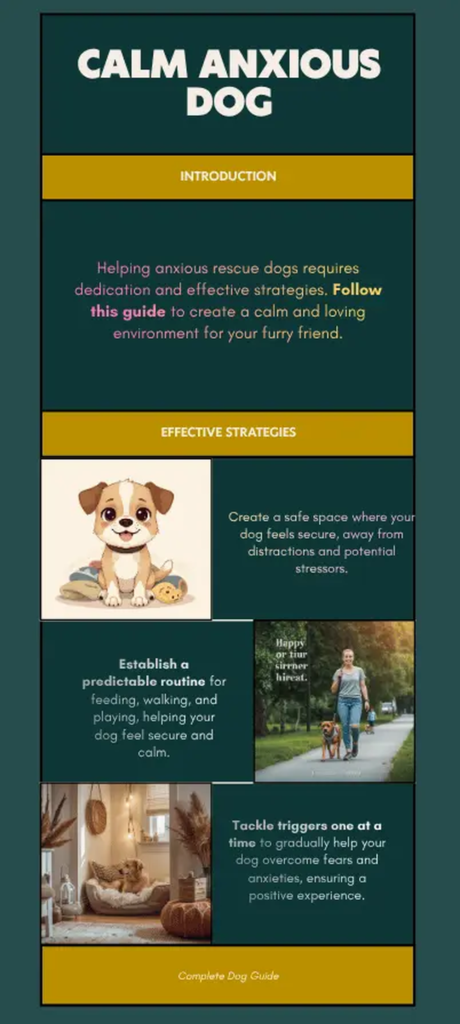
A rescue dog’s brain is wired by their history. Shelter life, re-homing, and past neglect train the nervous system to stay on high alert, because in those environments, alertness kept them safe. Time in a calm home helps, but the threat response stays switched on until you give the brain a reason and a method to switch it off.
This is also why the early adjustment window matters so much. If your dog is newly home, much of what you are seeing may be normal decompression rather than a lasting anxiety problem. For a full breakdown of the settling-in timeline and what to expect in the first days and weeks, read our guide to the 3-3-3 rule for rescue dogs. This article picks up where that one leaves off: the anxiety that lingers past the honeymoon phase and needs an active plan.
The 7-Step Plan to Calm an Anxious Rescue Dog
Work through these in order. Skipping ahead to trigger training before the foundation is set is the most common reason owners stall.
Step 1: Give Them a Safe Space
Before any training, your dog needs one spot in the house that is theirs and always feels safe. A crate with the door open, a corner with a bed, or a quiet room all work. Add a blanket, a worn t-shirt that smells like you, and keep the area away from foot traffic. If your dog struggles at night or hates being alone in that spot, a Snuggle Puppy (a plush toy with a heartbeat and a warm pack) genuinely helps some dogs settle, since it mimics the feel of a litter-mate.
Never use this space as punishment. It is a retreat, not a time-out. A dog who has somewhere to decompress recovers from stress far faster than one with nowhere to go.
Step 2: Lock In a Predictable Routine
Anxious dogs relax when the day is boring and predictable. Feed, walk, play, and rest at roughly the same times each day. The American Society for the Prevention of Cruelty to Animals lists routine as one of the first things to put in place for a stressed newly adopted dog, because predictability tells the nervous system that nothing bad is coming.
You are not building a rigid schedule for its own sake. You are removing the uncertainty that keeps an anxious brain firing.
Step 3: Use Desensitization and Counter-conditioning
This is the core method, and it is the one with the strongest scientific support. The idea is simple: expose your dog to the thing that scares them at a level so low they barely react, then immediately pair it with something wonderful like a high-value treat. Over many repetitions, the brain rewrites the association. The scary thing now predicts good things.
The non-negotiable rule, straight from the ASPCA’s behavior guidance, is that your dog should never experience the full-blown version of what frightens them during training. If they tip into panic, you moved too fast. Back up to an easier level. That is not a failure, it is the process working.
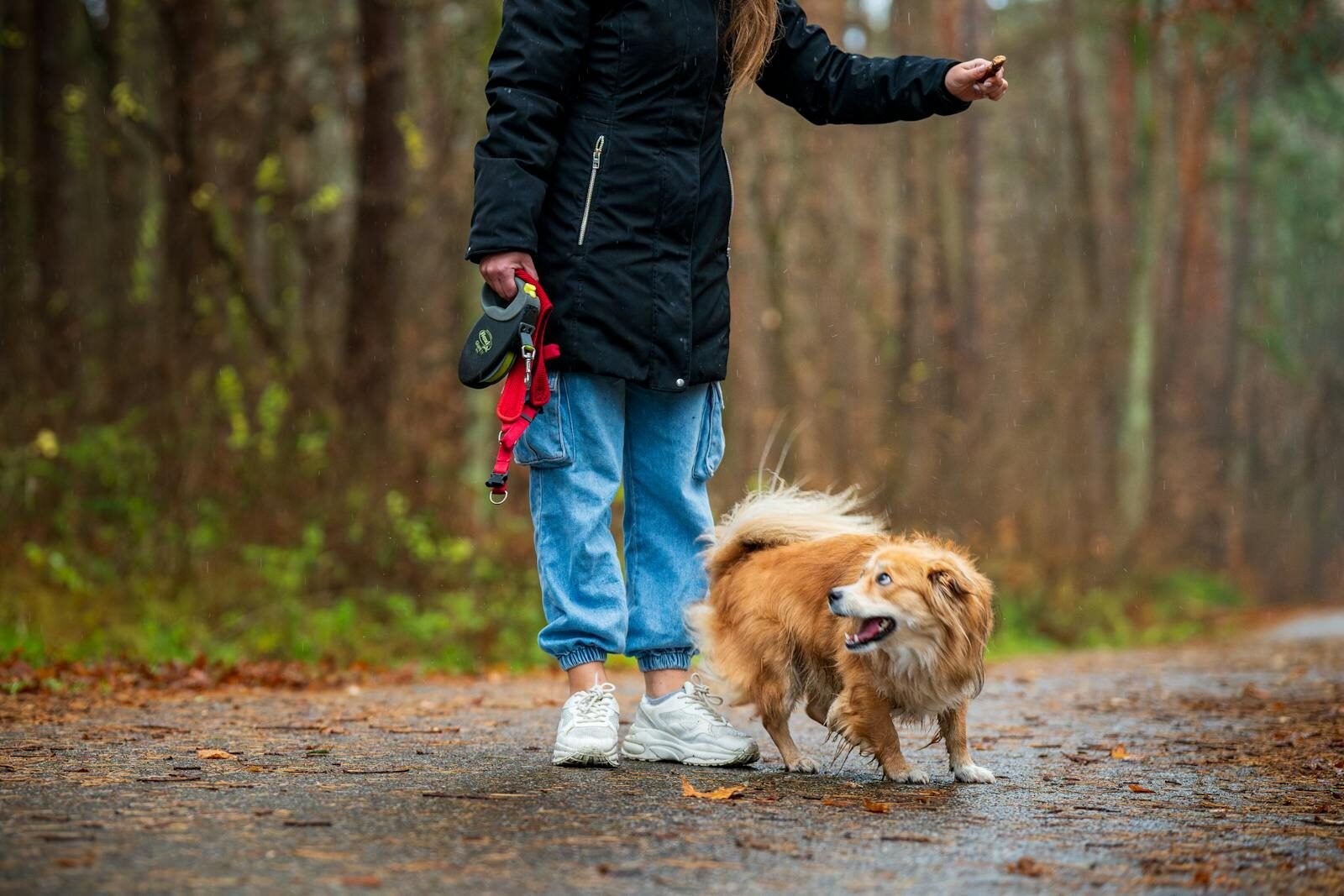
A worked example for a dog who fears strangers, based on guidance from the Animal Humane Society: keep enough distance that your dog notices the person but stays calm, then toss treats. Let the dog choose whether to approach. Do not force greetings, and ask visitors to avoid direct eye contact and ignore the dog at first. Distance is your dial. Turn it down only as the dog stays relaxed.
”One thing I keep noticing in the rescue communities I follow: owners who actually write down their dog’s threshold distance, even just in a phone note, make progress noticeably faster than the ones who go by feel. Guessing is where most people quietly drift too close, too soon.”
Step 4: Tackle the Big Triggers One at a Time
Most rescue-dog anxiety falls into a few buckets. Handle each one with its own version of Step 3.
Separation anxiety: This is one of the most common rescue issues, and it shows up as pacing, howling, destruction near exits, or accidents the moment you leave. The fix is graduated departures. The ASPCA recommends planning every absence to be shorter than the time it takes your dog to get upset, then extending in tiny increments. Once a dog can handle 40 minutes calmly, you can stretch absences in larger jumps, and a dog comfortable at 90 minutes can usually manage a normal workday.
A reader once told me her rescue would start trembling the moment she touched her work shoes, before she had even picked up her keys. That is how specific these departure cues get, and it is exactly why the fake-departure drills work so well.
Pair this with departure-cue training described by the AKC: pick up your keys or put on your coat, then sit down and make dinner instead of leaving. Repeat until the keys stop triggering panic, because right now those cues scream “abandonment” to your dog.
Two tools make this far easier. Stuff a Kong with peanut butter or wet food and freeze it, then give it only when you leave, so your dog starts to associate your exit with the best treat of the day. And set up a pet camera like a Furbo or a cheaper Wyze cam so you can actually watch where your dog’s calm tips into panic. Guessing the threshold is how most people move too fast.
Noise fears: For thunderstorms, fireworks, or the doorbell, start with a recording of the sound at a volume so low your dog stays calm, give treats while it plays, then raise the volume slowly across sessions (YouTube has free thunderstorm and firework tracks for exactly this). Combine it with the safe space from Step 1, a white-noise app or a fan to mask the real thing, and a snug wrap like a ThunderShirt, which applies gentle pressure that calms some dogs the way a swaddle calms a baby.
Resource guarding: If your dog guards food or toys, do not take items away, which only confirms their fear that things vanish. Instead, trade up. Approach, drop a higher-value treat, and let them learn that a human nearby means better things appear, not loss.
Step 5: Reward Calm, Never Punish Fear
This step is where good intentions go wrong. Punishing an anxious dog for barking, hiding, or having an accident does not reduce the fear. It adds your anger to an already frightening moment and teaches the dog that scary situations get even worse when you are around.
The American Veterinary Society of Animal Behavior is unambiguous on this. Based on current scientific evidence, AVSAB recommends reward-based methods only for all dog training, including behavior problems, and warns that aversive tools like prong, choke, and shock collars damage welfare and the human-animal bond with no proof they work better. The AVSAB’s guidance is to reinforce the behavior you want, remove whatever is rewarding the behavior you do not want, and address the underlying emotion driving it.
In plain terms: catch your dog being calm and reward that. A relaxed dog on their bed earns a quiet treat. You get more of what you reward.
Step 6: Add Calming Aids as Support, Not a Cure
This is where people waste the most money, so be clear-eyed about it. Calming aids take the edge off, but none of them rewire fear on their own. A dog-appeasing pheromone diffuser like Adaptil, a ThunderShirt, calming chews (brands like VetriScience Composure or Zesty Paws), and calming playlists made for dogs can all lower the baseline a little so the real training in Steps 3 and 4 sinks in faster. Lean on them as helpers. The owners who buy a diffuser, skip the training, and wonder why nothing changed are the ones who stay stuck for months.
Step 7: Know When Medication Is the Right Call
Sometimes the anxiety runs too deep for training alone to break through, and that is a medical reality, not a personal failure. For ongoing anxiety, vets sometimes prescribe SSRIs such as fluoxetine or clomipramine, according to the AKC. For specific stressful events like storms or vet visits, shorter-acting options exist that your vet may consider.
The key point that veterinary behavior specialists stress: medication is not an instant fix and is not a replacement for training. It lowers the baseline fear so the desensitization work in Steps 3 and 4 can actually take hold. Medication plus training beats either one alone. Always work with your vet, never an over-the-counter guess.
The Mistakes That Set Rescue Owners Back
Almost everyone who adopts an anxious dog trips on at least one of these. They feel like the right thing in the moment, which is exactly why they are so easy to fall into.
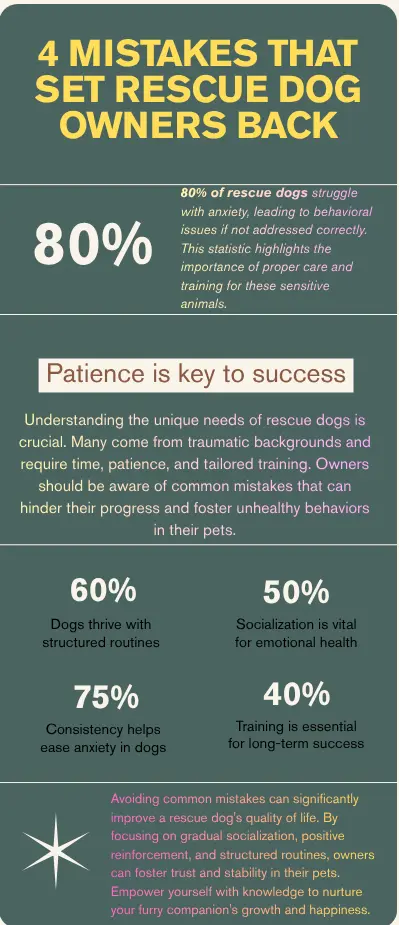
The four most common mistakes new rescue owners make, and what to do instead. Save this for the hard weeks.
Forcing socialization: This is the big one. You hear “your dog just needs more exposure,” so you take them to the dog park, and the meltdown that follows makes everything worse. Flooding a scared dog does not build confidence, it confirms to their brain that the world really is as dangerous as they feared. Slow and under-threshold wins every time. The dog park can wait six months. If your dog barks or lunges at other dogs on walks, that reactivity needs its own approach. Our guide on socializing a reactive dog walks through it step by step.
I have lost count of how many posts I have read that start with some version of ‘we took him to the dog park to socialize him, and now he is worse.’ It is easily the most common regret I see from new rescue owners.
Punishing the fear: When a dog soils the house out of panic or barks at the window, the instinct is to scold. But yelling at a frightened dog just teaches them that scary moments and your anger show up together. You end up with a dog who is afraid of the trigger and afraid of you.
Assuming time alone fixes it: This one is sneaky because people repeat it constantly: “give it time, they’ll settle.” Past the early decompression window, anxiety that gets no active plan tends to harden into a habit, not fade. Time only helps when you pair it with the work.
Rushing the timeline: You get a great week, so you jump three steps ahead, and one panic episode wipes out a month of progress. Patience here is not a personality trait, it is the actual method.
How Long Does It Take to Calm an Anxious Rescue Dog?
Mild anxiety can ease within a few weeks of consistent work. Moderate cases often take a few months. Severe anxiety, especially in dogs with trauma histories or multiple rehomings, can take six months to a year, and some need lifelong management.
Progress is rarely a straight line. Expect setbacks around stressful events, and judge success by the trend over weeks, not by any single day. If you are doing the steps correctly, you should see small wins early, like a dog who settles a little faster or reacts a little less.
When to Call a Vet or Behaviorist
Bring in a professional if your dog shows aggression, injures themselves trying to escape, refuses to eat, or stays in a state of panic you cannot bring down. Fear-based aggression is its own topic, and small breeds show it in specific ways. We cover this in detail in our guide to Chihuahua aggression. These are not problems to tough out alone.
For serious cases, look for a credentialed expert, not just any trainer. Certifications from the International Association of Animal Behavior Consultants (IAABC) or the Certification Council for Professional Dog Trainers (CCPDT) signal real, evidence-based training. A veterinary behaviorist can also rule out a medical cause hiding behind the anxiety and build a plan tailored to your dog.
A Last Bit of Encouragement
Here is what I want you to hold onto: your rescue dog is not broken, and you are not failing. Their brain learned to survive in chaos, and you are simply giving it the time and the repetition to learn something calmer. That is slow work, but it is real work, and it pays off. Every success story I have come across, and I have read hundreds while researching for this blog, follows the same boring script: small steps, repeated daily, for longer than felt reasonable. There is no shortcut version, and honestly, that should be encouraging. It means the method is the whole trick, not luck.
So pick a starting point this week. Set up the safe space and the routine. Next week, add one trigger to your desensitization plan. Reward every calm moment you manage to catch, even the small ones. The dog hiding under your bed right now can absolutely become the dog asleep at your feet, and everything you need to get there is in the plan above.
Quick Answers
How do I calm my rescue dog at night?
Set up a safe sleeping spot near you at first, keep a consistent bedtime, and use white noise to mask startling sounds. A worn t-shirt with your scent and a final calm potty walk help an anxious dog settle.
Why is my rescue dog still anxious after months?
A history of shelter life or neglect keeps the nervous system on high alert, and that does not reset on its own. Lasting calm comes from active desensitisation and counter-conditioning, not time alone.
Can an anxious rescue dog ever be fully calm?
Many do reach a genuinely relaxed state with consistent training, and some also need medication or lifelong management. Improvement is realistic for almost every dog, even if the timeline varies.
“This article is based on guidance from the ASPCA, the American Kennel Club (AKC), and the American Veterinary Society of Animal Behavior (AVSAB). It is educational and not a replacement for professional advice. If your dog’s anxiety is severe or includes aggression, consult your veterinarian or a certified behaviorist.”
Author Bio:
Faizan is the founder and writer behind Complete Dog Guide, a blog dedicated to helping dog owners with practical, well-researched information on dog food, care, grooming, and training. With 5 years of experience in content writing and blogging, he spends hours digging through veterinary publications, official guidelines from organizations like the AVSAB/ASPCA, AKC and the Merck Veterinary Manual to make sure every article is backed by reliable sources.